Friday, May 30, 2014

Is the mobility of protons in water high?

It is all relative.

I often read in physical chemistry papers statements along the line of "a major puzzle is the extremely high mobility of protons and hydroxide ions in liquid water ..... explaining this leads to consideration of non-diffusive transport mechanisms such as the Grotthuss mechanism."

Furthermore, a physics paper,  Ice: a strongly correlated system, cited by field theory enthusiasts [gauge theories, deconfinement, ....], states
ice exhibits a high static permittivity comparable with the one of liquid water, and electrical mobility that is large when compared to most ionic conductors. In fact, the mobility is comparable to the electronic conduction in metals.
It has taken a while for me to understand the real issues. Atkins' Physical Chemistry textbook actually has a helpful discussion, featuring the table below.


Thus, we see that the mobility of H+ and OH- (hydroxide) is about 3-7 times larger than that of other charged ions. This is hardly a gigantic effect!

Now, suppose the transport proceeds via diffusion. Then one can use the Stokes-Einstein relation to estimate the mobility of an ion in terms of the viscosity of the solvent (water).  This means the mobility scales inversely with the "hydrodynamic radii" of the diffusing particle. Atkins shows that this leads to reasonable estimates of the mobility [for ions in the bottom three lines to the Table above] with "hydrodynamic radii" of about 2 Angstroms.

But, H+ will be bound to H2O to form H3O+ which will be even larger thank K+ and so the mobility should be even smaller than for K+, not larger. OH- should be comparable.

Furthermore, the mobility of protons in ice would be dramatically less, since the solvent is no longer a fluid. However, the mobility at -5 degrees C is only a factor of six less than a 25 degrees C, as reported here.

Hence, it seems that proton transport cannot proceed by diffusion and it is necessary to consider alternative mechanisms such as the Grotthuss one.

Next, I should comment on the absolute magnitude of the mobility compared to a simple lower bound for coherent "hopping" transport, e^2 a^2/h ~ 1 V/(cm^2 sec), characteristic of energy bands. The value for H+ and OH- are about a factor of 30-50 smaller than this lower bound. Thus, water and ice are not even bad metals. Thus the claim in the physics paper of mobility comparable to electronic conduction in a metal is wrong.

Wednesday, May 28, 2014

The statistical mechanics of economic inequality

Economist Thomas Piketty has recently become a celebrity because of his new 700 page best selling book, Capital in the 21st century.

The latest issue of Science has a special section about "the science of inequality". It features a review by Piketty and his longtime Berkeley collaborator Emmanuel Saez. In the introduction the editors make an important point about an exciting future for economic research:
And in the past decade in developed capitalist nations, intensive effort and interdisciplinary collaborations have produced large data sets, including the compilation of a century of income data and two centuries of wealth data....
It is only a slight exaggeration to liken the potential usefulness of this and other big data sets to the enormous benefits of the Human Genome Project.
 
Researchers now have larger sample sizes and more parameters to work with, and they are also better able to detect patterns in the flood of data. Collecting data, organizing it, developing methods of analysis, extracting causal inferences, formulating hypotheses—all of this is the stuff of science and is more possible with economic data than ever before. 
Hopefully, economics will move beyond its current situation where there are popular introductory textbooks that contain virtually no real data, just schematic curves. Previously I wrote about how different the book Poor Economics is.

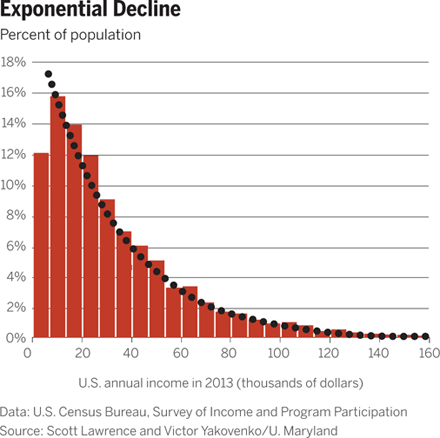
Econophysics does not get an article but a one page story with the graph below. It is the work of Victor Yakovenko [who I know for his nice work on angle-dependent magnetoresistance!] and is nicely described in a Reviews of Modern Physics Colloquium article. The essential "physics" is that income distribution follows an exponential [Boltzmann] distribution which can be derived on the assumption that through random "collisions/exchanges" the total amount of money [energy] is distributed among all citizens.


Tuesday, May 27, 2014

Quantum hydrogen bonds in antiferroelectric crystals

Ferroelectric materials develop a non-zero electric polarisation below a transition temperature, sometimes referred to as the Curie temperature Tc in analogue with ferromagnetic materials. Some materials have technological applications, including in dynamic RAM, as reviewed here.

The possibility of ferroelectricity and antiferroelectricity associated with different orderings of protons in some of the high pressure phases of ice is also a fascinating subject. In other materials hydrogen bonds also play a central role. Furthermore, the quantum dynamics of the protons is key, as revealed by isotope effects, where H is replaced with deuterium (D). For example, if you look in Ashcroft and Mermin, Table 27.4, you see that the transition temperatures of Potassium dihydrogen phosphate and Potassium dideuterium phosphate are 123 K and 213 K, respectively. This is a huge isotope effect! What does this tell us? What is its origin?

First, if we treat the nuclei classically, as in the Born-Oppenheimer approximation, the chemical bonding and potential energy surface is identical in the two crystals. What changes with H/D substitution? The vibrational energies (and quantum zero-point energy) of modes associated with the H/D. However, it remains controversial as to exactly what is going on. For example, how important is quantum tunnelling? See for example, this Nature paper from 1990 that argues it is all to do with changes in bond lengths.

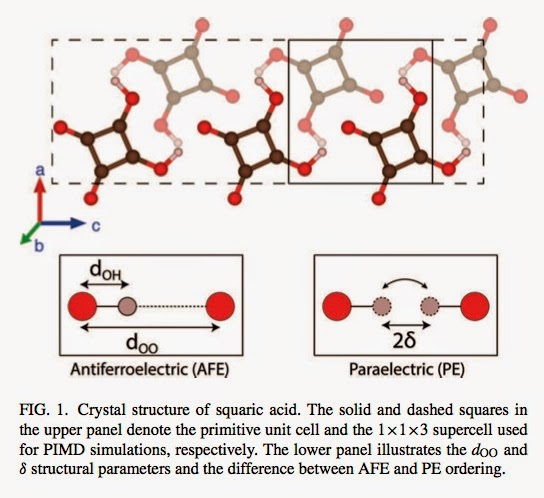
An H-bonded anti-ferroelectric material is squaric acid. What a cool name! The molecule and associated H-bonding pattern are shown below.


Dark brown, red, and light brown circles represent carbon,  oxygen, and hydrogen atoms, respectively. With H/D substitution, the transition temperature changes from 373 K to 520 K, again a huge effect.

The above figure is taken from a recent paper
Ab initio simulations of hydrogen-bonded ferroelectrics: Collective tunneling and the origin of geometrical isotope effects 
K. T. Wikfeldt and Angelos Michaelides

They perform path integral molecular dynamics simulations using potentials derived from density functional theory using the vdW-DF2 functional. They mention that the results are significantly different from the PBE functional, MP2 theory, and the random phase approximation. This is consistent with earlier work, discussed in an earlier post, that "ab initio" results from hydrogen bonding, particularly the energy barrier for proton transfer, vary significantly, with the level of approximation.

Two of the significant findings of this paper are:

1. There is a large secondary geometric isotope effect (SGIE), i.e, the distance d_OO shown above [the separation of the oxygen atoms that share the proton] increases by about 0.02 Angstroms with H/D substitution as found in experiment.

2. The H/D substitution leads to the deuterium being more localised than the proton. Thus the antiferroelectric phase is less stable for the H material, leading to a lower transition temperature, Tc, as is observed experimentally. [Since they consider a supercell of 3 units they cannot calculate Tc but can see how the probability distribution for the H and D varies with temperature.]

These results are of particular interest to me, because they are consistent with the findings of my recent H-bonding paper. For a simple semi-empirical model potential we found that when the d_OO distance [the donor-acceptor distance R in our paper] is about 2.55 A, as in squaric acid, the SGIE is about 0.02 Angstroms [Figure 7].

Furthermore, for R about 2.45-2.55 A, this SGIE significantly changes the underlying potential for H/D motion, meaning that the level of delocalisation (ground state probability distribution) changes significantly. Roughly the origin of this large effect is that for this R range the zero-point energy of H is comparable to the height of the energy barrier, whereas for D it is below the barrier. This difference leads to a large vibrational frequency isotope effect [Figure 8].

Saturday, May 24, 2014

Are scientific press conferences bad?

I fear that may be the case.
Previous cases of premature announcements include cold fusion, "life on mars" [really dead germs on meteorites from mars], neutrinos travelling faster than the speed of light, a Caltech theoretical chemist claiming he had solved high-Tc superconductivity,.....

In march BICEP2 scientists called a press conference to announce they had discovered evidence for cosmic inflation. This coincided with them placing a paper on the arXiv and Stanford releasing a Youtube video, that subsequently went viral, showing Andrei Linde being presented with the exciting news.

However, now questions are being asked. The chronology is described by Peter Woit on Not Even Wrong and there is a nice discussion of the science by Matt Strassler. The key issue seems to be the method used for subtracting the background signal due to galactic dust. It seems that BICEP2 scientists estimated this background signal by "scraping data" off the powerpoint slide from a talk given by their Planck competitors! But was this a robust estimate?

The issue has received coverage in the press including this Washington Post article.

I think there is a broader issue here of the role of rumours in the social media age. I am skeptical that one can have a forthright, robust, constructive, and thoughtful scientific discussion via tweets and blog rumours, when not all parties have access to the relevant information and there are a bunch of journalists watching. The problem is accentuated if people have already make strong public claims that have been further hyped up by the media and institutional press offices.

I thought that this issue of science via the media was a relatively new one. However, I learned this week that even Einstein was not immune from it! There is an interesting article in APS News, A Unified Theory of Journalistic Caution by science journalist Calla Cofield. She points out how Einstein went to the press to publicise his [now discredited] theory of distant parallelism. The New York Times covered it uncritically, since he was Einstein, after all.

Thursday, May 22, 2014

The uncertain status of career moves

An interesting question is: to what extent does the local institutional environment and the status of an institution affect the quality of the science done by an individual?
If I move to a more highly ranked institution will I do better science?
Or, if I move to a more lowly ranked institution will the quality of my work decline?

Some scientists are obsessed with "moving up", thinking that being at the "best" place is essential. They cannot fathom that one could do outstanding work at a mediocre institution.
However, consider the following. People at a high status university may get Nobel Prizes but that is not necessarily where they actually did the prize-winning work. Here are a few examples.

John Van Vleck: Wisconsin to Harvard
Joe Taylor: U. Mass to Princeton
Tony Leggett: Sussex to Urbana
William Lipscomb: Minnesota to Harvard

Can anyone think of other examples?

So can one actually measure how career moves affect the quality of science? One recent attempt is
Career on the Move: Geography, Stratification, and Scientific Impact
Pierre Deville, Dashun Wang, Roberta Sinatra, Chaoming Song, Vincent Blondel & Albert-László Barabási

The authors give an exhaustive analysis of the authors, affiliations, and citations of more than 400,000 papers from Physical Review journals, concluding
while going from elite to lower-rank institutions on average associates with modest decrease in scientific performance, transitioning into elite institutions does not result in subsequent performance gain. 
This made it into an article in the Economist magazine, entitled Why climb the greasy pole?
It is worth looking at the figure that this conclusion is based on, noting the size of the error bars.

The vertical axis is the change in citations and the horizontal axis the change in university ranking.

Wednesday, May 21, 2014

Comparing statistical mechanics to real data

I have posted before that I think it is very important in teaching to present students with comparisons of theory with actual experimental data. It is disturbing that many teachers and textbook writers make little effort to do this. On a positive note, here is a particularly nice comparison.

In PHYS4030 Condensed Matter Physics this week I am teaching Paramagnetism and diamagnetism, closely following chapter 31 of Ashcroft and Mermin.
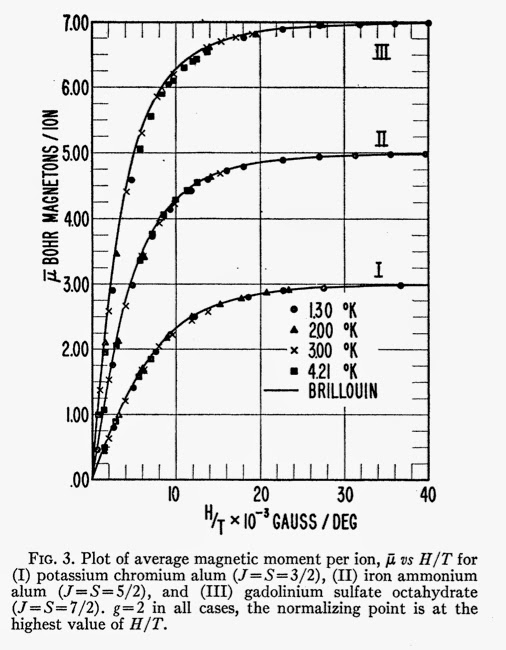
Consider non-interacting paramagnetic ions with total angular momentum J in a magnetic field B at thermal equilibrium at temperature T. Basic statistical mechanics can be used to derive an expression for the magnetisation, which is a universal function of B/T, known as the Brilloiun function. A&M do not compare this to experiment. However, I recalled that when I was an undergraduate we used a very nice book, Heat and Thermodynamics, [5th edition] by Mark Zemansky. It contains the comparison below, taken from a 1952 paper by Henry.

Tuesday, May 20, 2014

How many transition states are there on a potential energy surface?

Much of chemistry can be described in terms of potential energy surfaces. They describe the energy of an electronic state of a set of molecules as a function of the positions of the atoms in the molecules. Local minima on the surface describe stable molecules (reactants and products of chemical reactions). Chemical reactions proceed by thermal activation over saddle points (transition states). Hence, an interesting and important question concerns how many possible transition states there might be on a surface? How are the number of transition states related to the number of local minima?

In the process of writing a paper on double proton transfer I have stumbled across a very general result that I have never seen stated before. For me there is some curious personal history because the result uses a theorem in the first paper I ever published, thirty years ago, resulting from my undergraduate honours [final year] thesis on general relativity! More on that below.

Here is the result. Consider a smooth surface, i.e. one with no conical intersections, and with isolated extremal points.

I illustrate this below with two model surfaces for double proton transfer.

For example, in the bottom figure, 4+1-4=1.

Hence, if varying the system parameters introduces an extra maxima or minima then one additional saddle point must also appear. One can intuitively see how this works in two dimensions but it turns out it is true in any dimension.
This relation is a consequence of differential topology [essentially the Poincare-Hopf index theorem]. The minima and maxima are associated with an index +1 and saddle points with -1.
The general theorem I proved 30 years ago states that if a smooth function f(r) (where r is a vector) tends to infinity as the magnitude of r tends to infinity or if the gradient of f points outward
over a closed surface (curve in two dimensions), then the extrema of f inside that closed surface, must satisfy the above relation.

How might a potential energy surface satisfy this general requirement on f(r)=Energy(bond lengths)? Essentially it is because as one greatly stretches or compresses chemical bonds the energy of the system will become large.

Aside: it was really strange for me looking at my old paper, published in the Journal of the Australian Mathematical Society. I actually can't believe I wrote it! It is so formal and mathematical. There are parts of it I now struggle to understand. The theorem was not motivated by chemistry but rather proving a general theorem in general relativity that a gravitational lens must produce an odd number of images.

So, has anyone seen this result for potential energy surfaces stated before? I could not find it in David Wales' nice book Energy Landscapes.

What does this movie tell us about the modern university?

Last night, my wife and I watched the movie, Wit. You can watch the full movie here  (free with ads). I should warn that some of the conten...