Friday, February 28, 2014

A model public lecture

Scientists giving public lectures face a formidable challenge. It needs to be both interesting, exciting, and accessible to a broad audience. Hopefully, the speaker can communicate something not just about science but also about how science is done.

Yesterday I attended a very nice public lecture at UQ. Professor Ullrich Steiner from Cambridge spoke on How Nature Makes Materials. It nicely bridged physics, chemistry, and biology. His work on photonic structures in nature is described here.

The plant seed shown on the right is particularly amazing. Steiner and colleagues found a fifty year old one in a museum in Cambridge.


One thing, among others, that I appreciated was the lack of hype and the sober assessment of what his work in biomimetics has achieved. Sometimes it has provided some insight into how biological systems make and utilise specific materials. Some of the biomimetic materials and structures his group has made have some of the desirable features. But, most are also not yet commercially viable.

One minor comment.
In the introduction and motivation the notion was presented that evolution has produced optimal structures. I disagree with this commonly promoted claim.
Evolution does not optimise everything.
It just produces structures that work well enough to work together with many other components to increase probability of survival.

Thursday, February 27, 2014

Some basics for protecting your mental health

Late last year I gave a talk in Canberra for a group of scientists at CSIRO [Australia's government industrial research organisation]. This got a lot of positive feedback, and the associated blog post got a lot of page views. Several people told me the slide below is very helpful and so I post it here.
A group at CSIRO at Dutton Park [just over the river from UQ] has asked me to come and speak next month on the issue.

I would rather be getting science speaking invitations, but if this is helpful to others I am happy to do it.

Wednesday, February 26, 2014

Two historical questions about incoherent excitations

I believe that one of the most important concepts in quantum many-body physics is that of quasi-particles and the associated incoherent excitations. Often the one particle spectral function can be written in the form.


where the first term is a well-defined peak associated with quasi-particles and total spectral weight Z_k. 
The second term describes incoherent excitations, i.e., it has a weak dependence on the momentum k and as a function of omega is a broad distribution, in contrast to the sharp quasi-particle peak.
Futhermore, due to a sum rule [conservation of particle number] the total spectral weight of the incoherent part is 1-Z_k.

I think this equation is one of the most profound and important results in quantum many-body theory.

Some of this is illustrated in the figure below taken from a Nature Physics commentary by Nandini Trivedi.
The above equation and concepts have come to the fore over the past two decades due to wide studies of strongly correlated electron materials, particularly via dynamical mean-field theory and experimental ARPES [Angle-Resolved PhotoEmission Spectroscopy] studies.

I have two historical questions I am struggling to find answers for:

1. When and by whom was the equation above first clearly written down and elucidated?

I suspect sometime in the 1950-60s by Landau, Pines, Nozieres, Kadanoff, Baym, or Hubbard?
I looked in AGD and several other old books but could not find it.

2. When was the first time that the incoherent part of the spectral function was definitively observed in 
an experiment?

By this I don't mean just seeing some background [that could be noise], but actually showing that the incoherent background has the weight 1-Z_k. I presume an ARPES experiment in the past two decades.

I should know this, but just can't quickly find the answer.

Tuesday, February 25, 2014

A simple model potential energy surface for double proton transfer

I love simple models.

There is a very nice paper
Correlated double-proton transfer. I. Theory
Zorka Smedarchina, Willem Siebrand, and Antonio Fernández-Ramos

It considers an incredibly simple potential energy surface to describe double proton transfer.
x_1 is the (dimensionless) position of one proton relative to the middle of its donor and acceptor.
x_2 is the corresponding position for the second proton.
The first term describes a quartic potential with an energy barrier for transfer of the proton between the donor and acceptor.

The dimensionless parameter G describes the extent of correlation or coupling between the two hydrogen bonds. The coupling term is chosen to have the important property that it is symmetric in the two co-ordinates but sensitive to their sign. This is an important difference to earlier [rather nice] work by Benderskii et al. who considered competition between two dimensional quantum tunneling paths [instantons] associated with concerted and sequential transfer.

Three types of Potential Energy surface (PES) can occur, depending on the value of G.
The three cases shown below correspond to
a) 0 < G < 1/2
b) 1/2 < G < 1
c)  G > 1.
The coordinates x_a=1/2(x_1-x_2) and x_s=1/2(x_1+x_2). The horizontal line between the left and right minimum corresponds to a concerted path.
For the top PES a sequential proton transfer is possible via one of the two intermediate (INT) states.

These three cases correspond to the different types of PES's seen for double proton transfer for different molecules.

Monday, February 24, 2014

Teaching innovation: one step forward, one step backward

It great to try new things in teaching. We desperately need to when we are honest about how little many students actually learn, particularly with traditional modes of delivery. Technology also makes possible all sorts of things.

People will often promote innovations; but sometimes a few years later it is found that they don't work as well as they did or were hoped to. Yet I suspect that sometimes, because of disappointment or embarrassment, the proponents are a bit coy about making known regressions.
So in the interest of transparency and to promote discussion here are a couple of mine. They both relate to a course PHYS4030: Condensed Matter Physics that I have taught on of off for the past ten years. It is a final year undergraduate course that basically covers approximately half the material in Ashcroft and Mermin.

A few years ago I introduced three innovations. Both seemed to work for a while.

Formative and summative assessment following the example of another undergraduate course I was involved in. Students must complete a certain minimum amount of work [attendance, writing on the course blog, assignments, ...] to pass the course but this has little effect on their final grade.

A course blog that students must post and comment on several times a week. I did this because it had worked earlier in a biophysics reading course I taught.

Students give a talk on a recent research paper [often from a luxury journal] that relates to the course.

I won't be doing any of the three this year.
Why? Basically, for the same reason as
Confession of an Ivy League teaching assistant: Here’s why I inflated grades
It is not worth the hassle of dealing with student complaints.

It seems some students think they should "credit" for all the work they do. Some read the course profile to mean they could make all their posts on the blog in the last week. Some didn't see why they should have to attend the paper talks of their classmates. Some also had rather different views to me about what grade they should get for their talks.

So, for now I am reverting to the old traditional assessment: exams and assignments.

I welcome comments and suggestions.

Friday, February 21, 2014

Extracting the self energy from ARPES

I read an interesting PRL
High-Energy Anomaly in the Band Dispersion of the Ruthenate Superconductor
H. Iwasawa, Y. Yoshida, I. Hase, K. Shimada, H. Namatame, M. Taniguchi, and Y. Aiura

They perform ARPES [Angle Resolved Photoemission Spectroscopy] on strontium ruthenate [Sr2RuO4]. Some of the main results are shown below [the vertical scale is energy].
The key issue is understanding how the measured quasi-particle dispersion (left panel) differs from the band structure calculated from LDA [Local Density Approximation of Density Functional Theory (DFT)].
Where the two curves cross is the "high energy anomaly". This is very much related to "kinks" and "waterfalls" in the cuprates, as I discussed in an earlier post.


The spectrum is compared to a very simple model self energy (right panel) that is consistent with Fermi liquid theory and includes a "cut off" energy scale associated with the underlying interactions [bosons?, magnons?, electron-electron?] that are the origin of the self energy.

The solid black curve in the right panel above is from a theoretical calculation [self-consistent perturbation theory and DMFT on the relevant multi-band Hubbard model with Hunds rule coupling]. [A 2000 PRL by Liebsch and Lichtenstein].
It is very impressive that this agrees with the experiment.
This shows how good both ARPES and Dynamical Mean-Field Theory are getting.

I found some of the discussion of theory in the paper poor and confusing. For example, I failed to see how Zhang-Rice singlets are relevant to the ruthenates.
But the biggest concern was they make a big deal of the value of the energy of the anomaly and try and compare it to other energy scales such as the Hubbard U and the Hund's rule coupling J. This is simplistic. The whole of point of work described in  my earlier post is that this energy scale is emergent and does not have a simple relationship with the energy scales of the underlying interactions.

I would have also like to see a comparison with the recent LDA+DMFT calculations of Jernez Mravlje and collaborators that I discussed here.

Thursday, February 20, 2014

What is the minimal one-band Hamiltonian for sodium cobaltates?

I would say an ionic Hubbard model on the triangular lattice.

About a decade ago sodium cobaltate [NaxCoO2] was the "flavour of the month" when it came to strongly correlated electron materials. And then along came the iron pnictide superconductors....

The cobalt ions within a layer of the crystal structure form a triangular lattice and the sodium ions donate electrons to conducting layers. Hence, it is natural to consider a doped Hubbard model on a triangular lattice as the simplest possible effective Hamiltonian for these materials.
This led to numerous studies of this model. Today most studies of this model will  also claim relevance to sodium cobaltates. I disagree.

The sodium ions play a larger role that cannot be neglected. They actually modify the intra-layer electronic structure. Specifically, they spatially order in a manner dependent on the doping level.
This is unlike the case of the cuprates where the atoms between layers [and dopants] are merely spacers and do not change with doping.

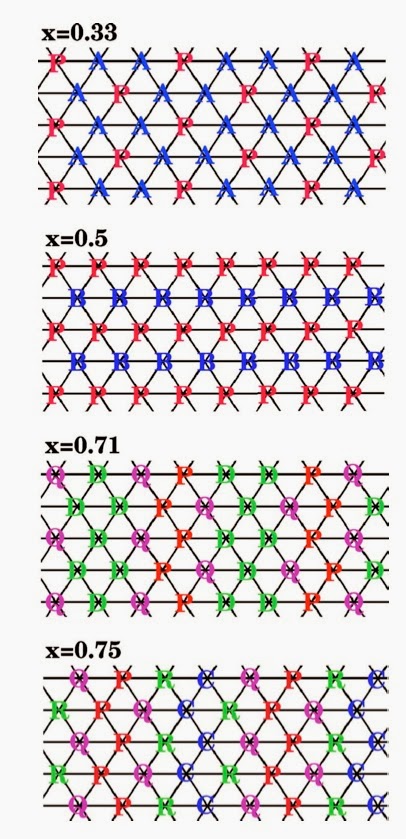
Jaime Merino, Ben Powell, and I discussed this in a series of papers, discussed in an earlier post. In a 2006 PRB we considered the simple one band Hubbard model and pointed out that it could not describe all the cobaltates properties. The figure below shows how the spatial ordering of the sodium ions at different dopings produces different site energies on the triangular lattice.

What does this movie tell us about the modern university?

Last night, my wife and I watched the movie, Wit. You can watch the full movie here  (free with ads). I should warn that some of the conten...