Wednesday, September 30, 2009

Strong electronic correlations in cerium oxides


One of my students, Elvis Shoko has just submitted his Ph.D thesis, entitled "A minimal model Hamiltonian for strong electron correlations in cerium and its oxides".
Well done, Elvis!

We welcome any feedback.

Mac vs. PC


I am due to buy a new laptop and so am considering switching from a PC to a Mac (probably a 13 inch Macbook Pro). Over the past couple of years some of my colleagues have made this switch and are happy with it. I welcome other views. John Fjaerestad sent me this link which appears to have lots of useful info and practical tips for physicists who make the switch to Mac's.

Something I have heard enthusiastic reviews about is Papers, the program for organising ones files and files of downloaded papers.

Tuesday, September 29, 2009

Give and take in organometallic complexes


Following up on my previous post on pi-back-bonding in organometallic complexes I came across this nice paper which considers a complex which has such strong interaction between the LUMO on the organic ligand and one of the d-orbitals on the metal (actually the metal plus some other ligands) that the bond is almost covalent.

Above I reproduce the nice figure from the online abstract since it summarises the paper so nicely and unfortunately is not in the paper.

Sunday, September 27, 2009

Measuring Planck's constant by thermodynamics

An incredibly important and useful equation is the Sackur-Tetrode equation which gives the absolute entropy of an ideal gas and shows how

-Planck's constant enters statistical mechanics in a way that is measurable
-to resolve the Gibbs paradox

I did not appreciate just how significant the equation was until I taught a statistical mechanics course.

The latest APS News has a beautiful article by Richard Williams on the equation in the This Month in Physics History column.

Did you know Tetrode as only 17 when he derived the equation from Boltzmann's equation (see below)!

Saturday, September 26, 2009

The limited role of quantum effects in proton transfer in enzymes


I am just finishing up a paper which gives a detailed analysis of the possible role of quantum effects in proton transfer in enzymes. Above I reproduce a key figure from the paper (if you left click on it, you can view a larger version)

This follows a series of posts:
the first discussed the claims that proton transfer in enzymes occurs predominantly by quantum tunneling below the transition state associated with the transition state.
the second reviewed beautiful experiments by Doll and Finke which were inconsistent with Klinman's hypothesis that enzymes have evolved to promote tunneling, and
the third post reviewed Quantum transition state theory and how instantons provide a natural description of quantum tunneling.

The Figure shows that a quantitative description of the Doll and Finke data is possible without instantons, i.e., the only quantum effects are those associated with fluctuations around the transition state.

Friday, September 25, 2009

John Cleese on reductionism

On the lighter side here is a video of John Cleese discussing genetic determinism, quantum physics, reductionism, God, coconut ice cream, and the usual silly stuff...

Thursday, September 24, 2009

Why do molecules absorb and emit light?

Today at the fortnightly "cake meeting" (a condensed matter theory group meeting) I am giving a tutorial on optical transition dipole moments. This key quantity determines:
  • the probability that a photon will be absorbed by a molecule which then makes a transition to an electronic excited state
  • the polarisation of the light that is absorbed and emitted by the molecule
  • the rate at which the excited state decays by emitting radiation
  • the strength of the van der Waals interaction between pairs of the molecule
  • FRET=Forster Resonant Energy Transfer, where an excited state can be transferred to a neighbouring molecule
Here are some of my notes which contain the key equations and ideas.
Some of the relations and key references are in this paper I co-authored on Transition dipole strength of melanin.
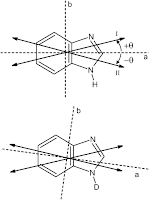
What determines these transition dipole moments? How do we make them large?
A key aspect is that they involve delocalisation of charge in both the ground and excited state.
This becomes apparent in this extract from Nitzan's book which shows how the transition dipole moment is proportional to the distance between the two centres over which the charge is delocalised and the Hamiltonian matrix element between orbitals localised on these two centres.

The direction of the transition dipole moment tends to be parallel to a vector joining the two centres.

What does this movie tell us about the modern university?

Last night, my wife and I watched the movie, Wit. You can watch the full movie here  (free with ads). I should warn that some of the conten...