while a simple and absolute law, such as hydrodynamics, can evolve from the deeper laws underneath, it is at the same time independent of them, in that it would be the same even if the deeper laws were changed.
Thinking through these effects seriously moves one to ask which law is the more ultimate, the details from which everything flows or the transcendent, emergent law they generate. That question is semantic and thus has no absolute answer, but it is clearly a primitive version of the moral conundrum raised by the alleged subordination of the laws of living to the laws of chemistry and physics. It shows allergorically how a person could easily master one and learn nothing whatsoever about the other. The epistemological barrier is not mystical but physical.
The conflict between these two conceptions of the ultimate: the laws of the parts or the laws of the collective is very ancient and not resolvable in a few minutes’ reflection or a casual conversation. One might say it represents the tension between two poles of thought, which drives the process of understanding the world the way the tension between the tonic and dominant drives a classical sonata. At any one time in history a given pole may be stronger than the other, but its predominance is only temporary, for the essence of the plot is the conflict itself.
Monday, August 31, 2009
Emergence versus reductionism
In the final chapter of his book, A Different Universe, Bob Laughlin states:

Saturday, August 29, 2009
Watching Mott and Hubbard kill quasi-particles
This morning I gave a seminar, "Destruction of quasi-particles near the Mott insulator transition" to the Condensed Matter Physics group at University of Toronto. A few points I tried to emphasize in the talk were:
The frequency dependent optical conductivity is a powerful probe of many-body effects in strongly correlated electron materials. In particular, for a wide range of materials one observes a significant redistribution of spectral weight, with only a small amount of weight in the Drude peak, which often only exists at temperatures much less than the energy scales associated with the band structure.
The absence of a Drude peak is associated with destruction of Fermi-liquid quasi-particles. Other signatures of a bad metal include a non-monotonic temperature dependence of the resistivity, thermopower, and Hall constant.

Dynamical mean-field theory gives a quantitative description of the redistribution of spectral weight in organic charge transfer salts near the Mott-Hubbard insulating phase.
The talk was largely based on this PRL, a combined theory and experiment work.
The frequency dependent optical conductivity is a powerful probe of many-body effects in strongly correlated electron materials. In particular, for a wide range of materials one observes a significant redistribution of spectral weight, with only a small amount of weight in the Drude peak, which often only exists at temperatures much less than the energy scales associated with the band structure.
The absence of a Drude peak is associated with destruction of Fermi-liquid quasi-particles. Other signatures of a bad metal include a non-monotonic temperature dependence of the resistivity, thermopower, and Hall constant.

Dynamical mean-field theory gives a quantitative description of the redistribution of spectral weight in organic charge transfer salts near the Mott-Hubbard insulating phase.
The talk was largely based on this PRL, a combined theory and experiment work.
Friday, August 28, 2009
Quantifying quantum decoherence of electronic excitations of moleucles in condensed phases
This afternoon I am giving my talk at the conference. Most of it is based on this review article. Main ideas I want to get across are:
-the main source of decoherence of electronic excitations in large molecules is due to the dielectric relaxation of the environment
-this can be quantified in terms of a spectral density, many of which have been determined experimentally from dynamic Stokes shift measurements
-the relevant time scales are 10's to 100's femtoseconds
-the main source of decoherence of electronic excitations in large molecules is due to the dielectric relaxation of the environment
-this can be quantified in terms of a spectral density, many of which have been determined experimentally from dynamic Stokes shift measurements
-the relevant time scales are 10's to 100's femtoseconds
Thursday, August 27, 2009
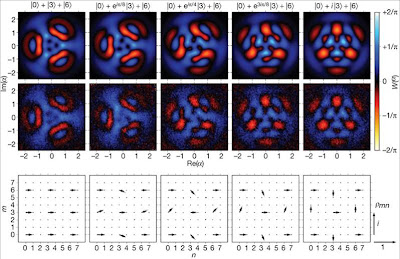
Dial a quantum state!
Today John Martinis presented some amazing experimental results showing how using superconducting phase qubits coupled to a transmission line one can synthesize arbitrary superpositions of photon number states. The figure below is taken from a recent Nature paper
Slide 1

Wednesday, August 26, 2009
Is optimal control quantum, semi-classical, or classical?
I had a great meeting with Paul Brumer today, where he answered many of the questions I posted previously about quantum control. Here are just a few of the things I learnt:
In a 2005 PRL, Paul and Hoki did a careful analysis of experiments on the optimum pulses for photo-isomerisation of the dye NK88 in methanol. They found that the optimum pulses corresponded to an incoherent pump-dump scenario and that quantum interference effects were absent.
In a J. Chem. Phys. papers in 2005 and 2006 Christopher, Shapiro, and Brumer considered the pulse sequences needed to optimise internal conversion of S2 to S2 in pyrazine by considering the full time evolution of an effective Hamiltonian for these two states taking into account 24 vibrational modes. They found "active control over internal conversion so as to almost completely suppress the process over time scales of ~50–100 fs [well in excess of the natural internal conversion times (~20 fs)] or to accelerate it to complete internal conversion in less than 5 fs". One thing I want to understand better is how this relates to a conical intersection picture for internal conversion.
A recent experimental paper in PNAS found quantum coherence did not play a significant role in the isomerisation of retinal in bacteriorhodopsin, presenting a different view from a 2006 Science paper from Miller's group in Toronto.
In a 2005 PRL, Paul and Hoki did a careful analysis of experiments on the optimum pulses for photo-isomerisation of the dye NK88 in methanol. They found that the optimum pulses corresponded to an incoherent pump-dump scenario and that quantum interference effects were absent.
In a J. Chem. Phys. papers in 2005 and 2006 Christopher, Shapiro, and Brumer considered the pulse sequences needed to optimise internal conversion of S2 to S2 in pyrazine by considering the full time evolution of an effective Hamiltonian for these two states taking into account 24 vibrational modes. They found "active control over internal conversion so as to almost completely suppress the process over time scales of ~50–100 fs [well in excess of the natural internal conversion times (~20 fs)] or to accelerate it to complete internal conversion in less than 5 fs". One thing I want to understand better is how this relates to a conical intersection picture for internal conversion.
A recent experimental paper in PNAS found quantum coherence did not play a significant role in the isomerisation of retinal in bacteriorhodopsin, presenting a different view from a 2006 Science paper from Miller's group in Toronto.
Tuesday, August 25, 2009
Trying to disentangle my incoherent thoughts
Here a few notes and comments on some of todays talks on the Conference on Quantum Information and Quantum Control in Toronto.
Andrew White (University of Queensland)
Quantum Chemistry on a Quantum Computer: First Steps and Prospects
He showed some nices pictures of potential energy surfaces. In passing I mention that John Polanyi, a long-time faculty member in Chemistry at U. Toronto who shared a Nobel Prize in 1986 for illuminating the significance of such surfaces for reaction kinetics.
Essentially the work described seems to be diagonalising a 2x2 matrix on a quantum computer (by the phase estimation algorithm). It was not clear from the talk how the matrix elements in this matrix were evaluated since they involve performing various real space integrals (i.e., matrix elements) of the real space Hamiltonian. Practical quantum chemists would say that evaluating such integrals is an essential part of a real calculation. Even disregarding this issue calculations with more realistic basis sets will require many more qubits. Hence, I wonder if a better direction for such simulations of quantum systems is to focus on simulating systems with small Hilbert spaces interacting with an environment. The simplest such model Hamiltonian would be the spin-boson model. Simulating the quantum dynamics of this on classical computer is a real challenge but in a quantum computer simulation one could have the significant advantage that an artiificial source of decoherence would have few cost overheads...
Shohini Ghose (Wilfrid Laurier University)
Entanglement and nonlocality in multiqubit pure states
This is based on a recent PRL.
Consider pairs of qubits in a pure state. Then the states are entangled if and only if they violate Bell-type inequalities. [If the state is mixed then Werner showed there exist states which are entangled but not violate Bell].
For 3 qubits one can uses the 3 particle tangle (introduced by Coffman, Kundu, and Wootters) to quantify entanglement and there is an inequality due to Svetlichny which is the 3-qubit generalisation of Bell-CSCH inequalities.
A few really striking aspects of the results presented
(they are "counter-intuitive" because they are different to what occurs in the 2 qubit case) :
Chris Monroe (University of Maryland)
Quantum Networks with Ions, Phonons, and Photons
Chris showed how to simulate a 3 spin Ising model in a transverse field. The spin-spin interaction is mediated by phonons (i.e., relative motion of the ions). Given the state of ion trap technology extending this to as many as 10 spins. This should make possible some of the simulations that Gerard Milburn and I considered several years ago with a student John Paul Barjaktarevic and described here. These have the significant advantage that one does not have to worry about Trotter decomposition.
well its midnight in Toronto and 2pm in brisbane.... time to go back to bed and try and get over the jet lag....
Andrew White (University of Queensland)
Quantum Chemistry on a Quantum Computer: First Steps and Prospects
He showed some nices pictures of potential energy surfaces. In passing I mention that John Polanyi, a long-time faculty member in Chemistry at U. Toronto who shared a Nobel Prize in 1986 for illuminating the significance of such surfaces for reaction kinetics.
Essentially the work described seems to be diagonalising a 2x2 matrix on a quantum computer (by the phase estimation algorithm). It was not clear from the talk how the matrix elements in this matrix were evaluated since they involve performing various real space integrals (i.e., matrix elements) of the real space Hamiltonian. Practical quantum chemists would say that evaluating such integrals is an essential part of a real calculation. Even disregarding this issue calculations with more realistic basis sets will require many more qubits. Hence, I wonder if a better direction for such simulations of quantum systems is to focus on simulating systems with small Hilbert spaces interacting with an environment. The simplest such model Hamiltonian would be the spin-boson model. Simulating the quantum dynamics of this on classical computer is a real challenge but in a quantum computer simulation one could have the significant advantage that an artiificial source of decoherence would have few cost overheads...
Shohini Ghose (Wilfrid Laurier University)
Entanglement and nonlocality in multiqubit pure states
This is based on a recent PRL.
Consider pairs of qubits in a pure state. Then the states are entangled if and only if they violate Bell-type inequalities. [If the state is mixed then Werner showed there exist states which are entangled but not violate Bell].
For 3 qubits one can uses the 3 particle tangle (introduced by Coffman, Kundu, and Wootters) to quantify entanglement and there is an inequality due to Svetlichny which is the 3-qubit generalisation of Bell-CSCH inequalities.
A few really striking aspects of the results presented
(they are "counter-intuitive" because they are different to what occurs in the 2 qubit case) :
- There exist tripartite entangled states that do not violate the Svetlichny inequality.
- The tangle is not a smooth function of the state coefficients.
Chris Monroe (University of Maryland)
Quantum Networks with Ions, Phonons, and Photons
Chris showed how to simulate a 3 spin Ising model in a transverse field. The spin-spin interaction is mediated by phonons (i.e., relative motion of the ions). Given the state of ion trap technology extending this to as many as 10 spins. This should make possible some of the simulations that Gerard Milburn and I considered several years ago with a student John Paul Barjaktarevic and described here. These have the significant advantage that one does not have to worry about Trotter decomposition.
well its midnight in Toronto and 2pm in brisbane.... time to go back to bed and try and get over the jet lag....
James Bond meets Niels Bohr!
At the conference today my UQ colleague Andrew White pointed out that if you type "Daniel James quantum" into Google the first two entries that appear are for the conference chairman, who rates higher than Daniel Craig as James Bond in Quantum of Solace!
Andrew then showed a clip from the movie which showed James Bond interrogating a poor "graduate student" who says:
Andrew then showed a clip from the movie which showed James Bond interrogating a poor "graduate student" who says:
I answered all your questions. I told you everything you wanted to know about quantum.I should also mention that Daniel Craig actually stars as Werner Heisenberg in a PBS production of the play, Copenhagen! You can see some of the video here, and a key scene about the uncertainty principle.

Subscribe to:
Posts (Atom)
What does this movie tell us about the modern university?
Last night, my wife and I watched the movie, Wit. You can watch the full movie here (free with ads). I should warn that some of the conten...

-
 This week Nobel Prizes will be announced. I have not done predictions since 2020 . This is a fun exercise. It is also good to reflect on w...
 -
 The Ising model is a paradigm in both statistical mechanics and condensed matter physics. Today for most theorists it is so familiar that so...
 -
 Nitrogen fluoride (NF) seems like a very simple molecule and you would think it would very well understood, particularly as it is small enou...